
 This vintage Wegner-style folding chair was made in Yugoslavia. It was one of a pair that I redid recently.
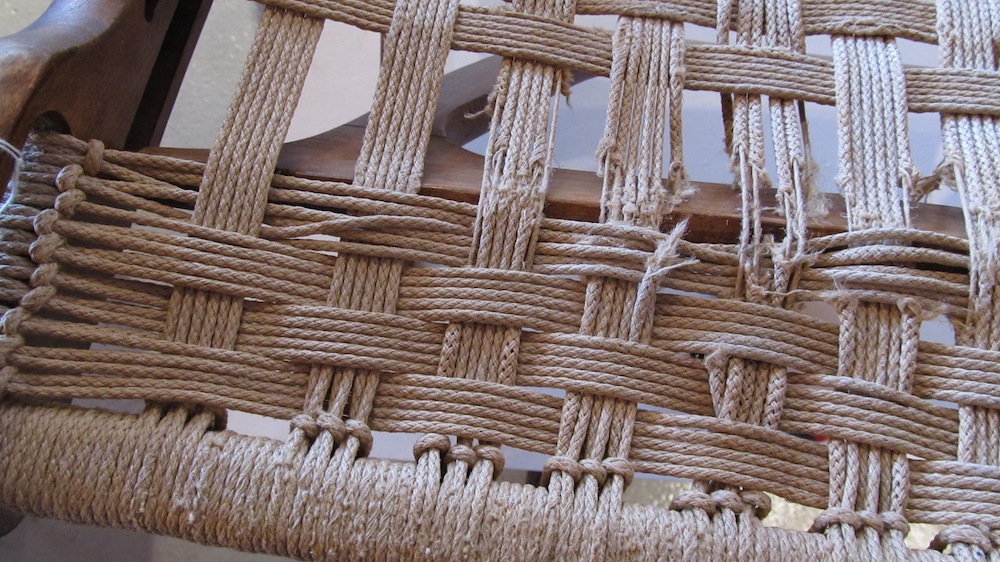 The original cotton cord was very worn with lots of broken strands. I forgot to take photos of the whole chairs, as usual!
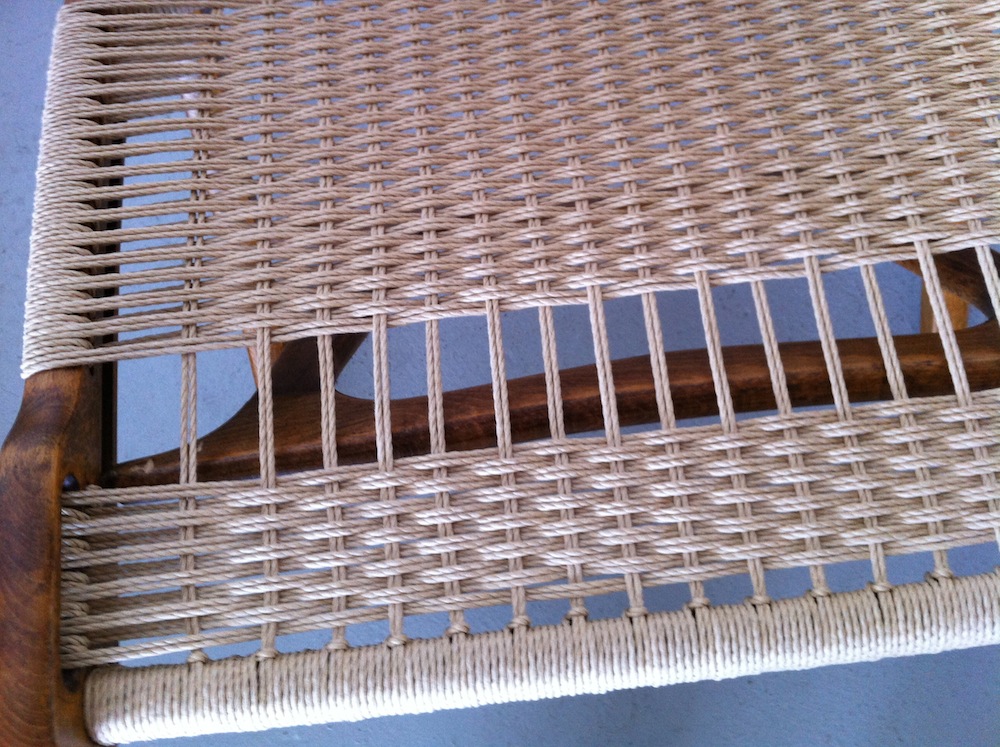 Same shot of the seat, redone with Danish paper cord which wears better than the cotton cord on the originals. I think the cotton cord also stretches more than the paper cord, which you do not want.
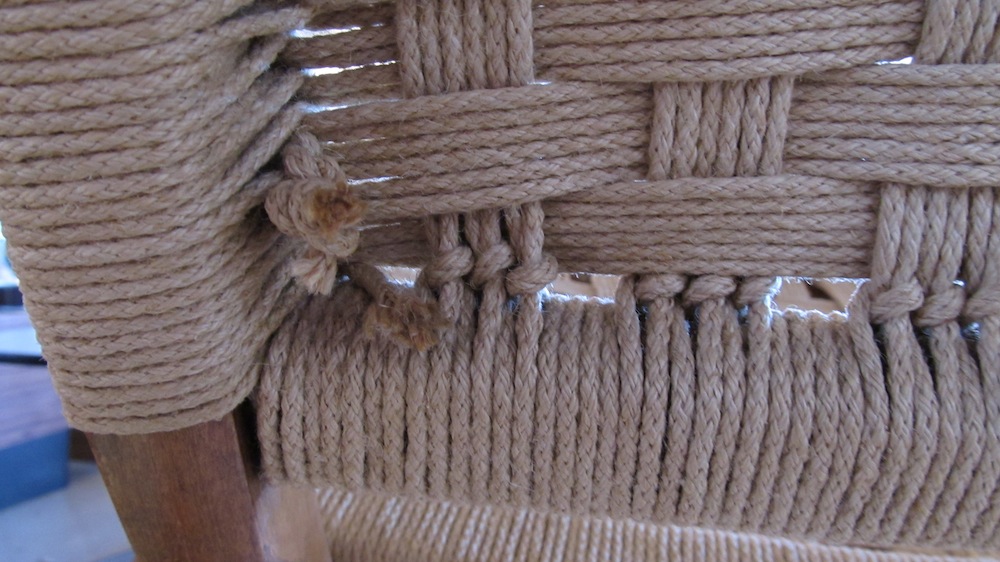 The originals had a lot of knots like this one showing on the back.
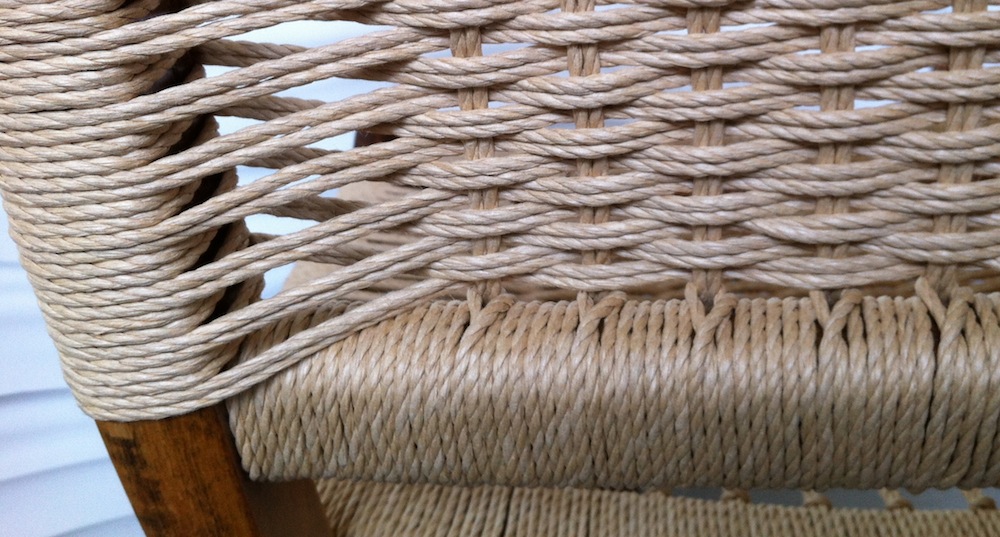 I used a different weaving technique on the sides and also took care to attach all new strands with hidden staples instead of knots.
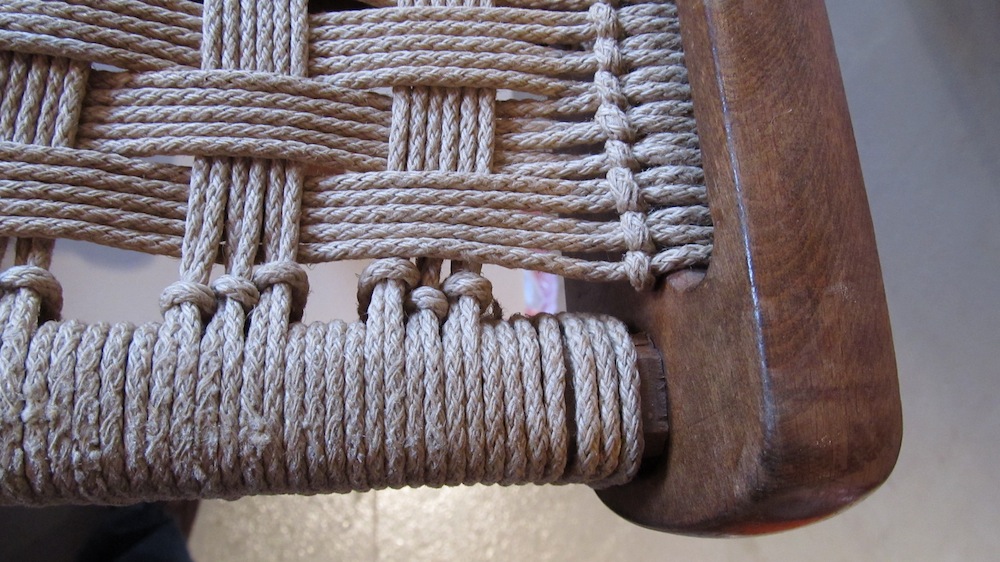 The originals always have these wrapped strands which end up bunched together unevenly. Not a very sleek look.
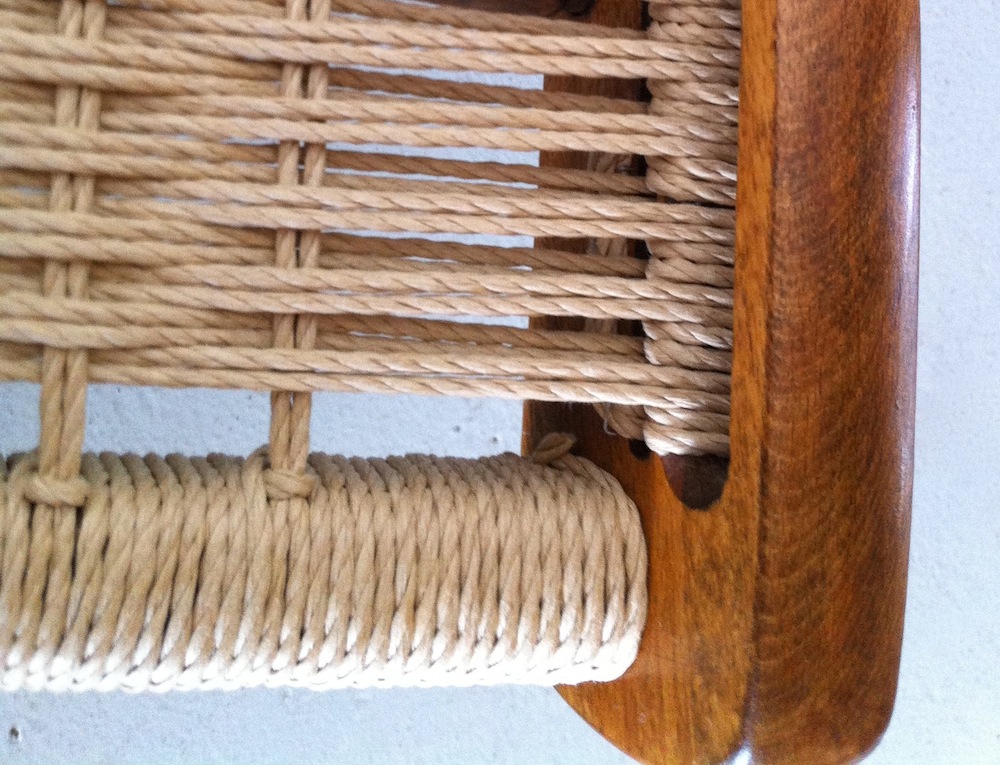 With my method, there are wrapped strands but with wider spacing to avoid the bunched look. And the side rails do not have those little wraps at all.
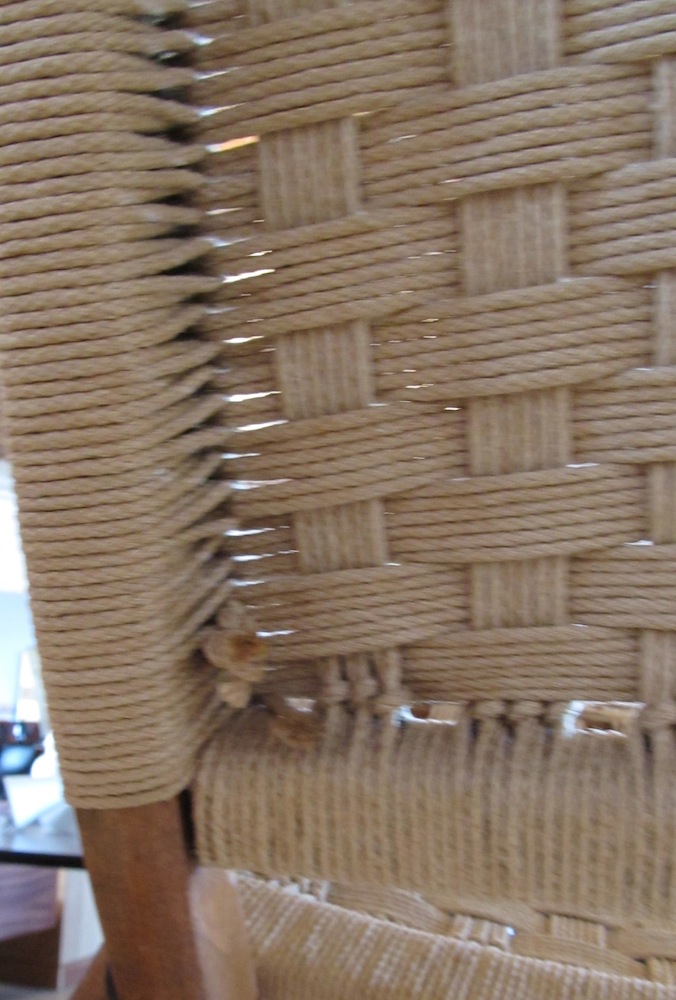 Another knot.
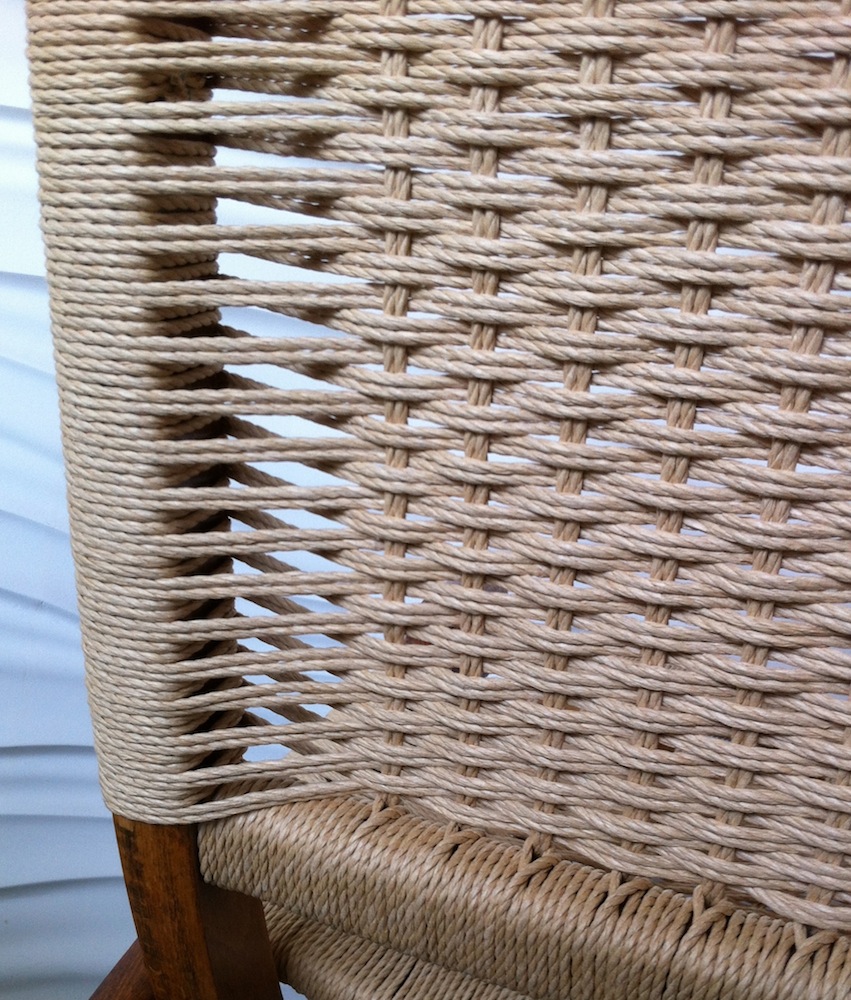 No knots, and that overlap on the lower rail turns into a pretty detail when repeated.
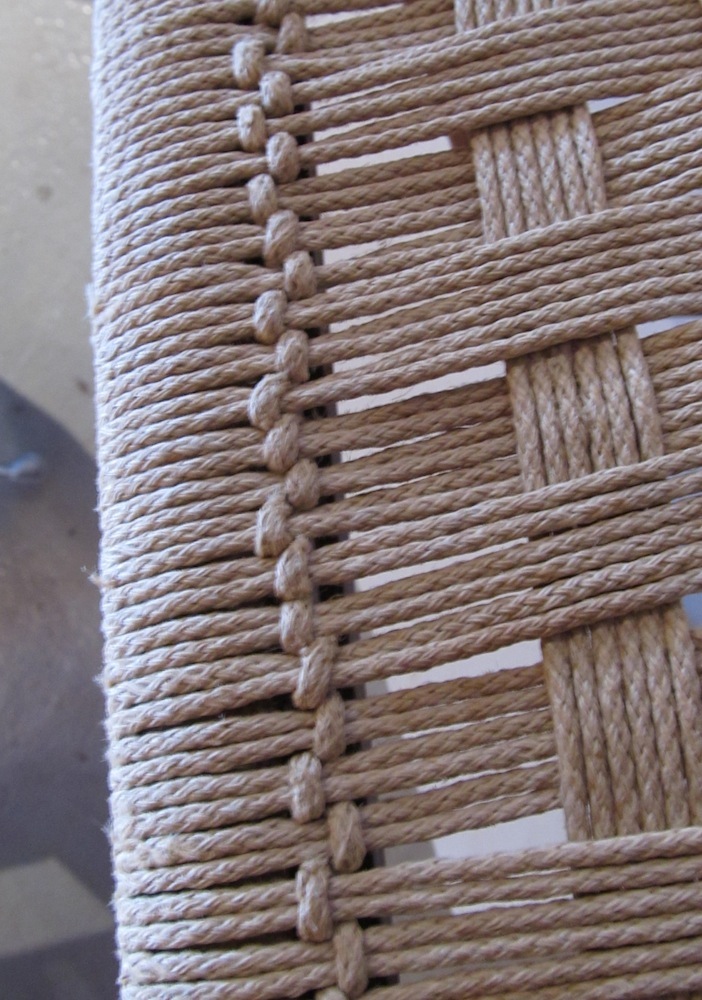 One more shot of those bunched-up wraps. Last one, I promise.
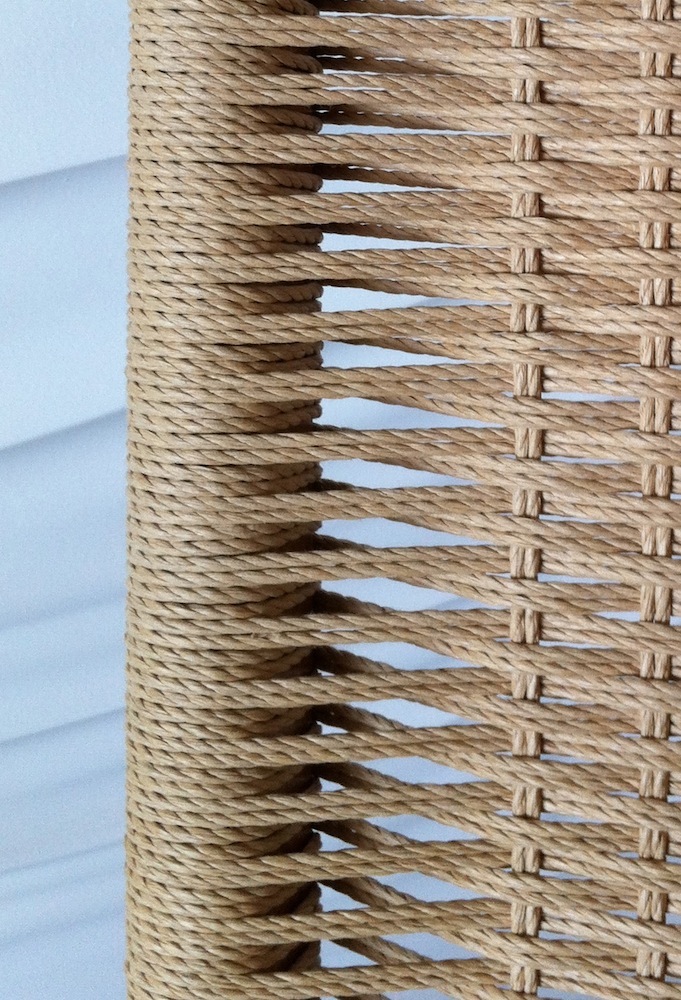 These invite strumming, no?
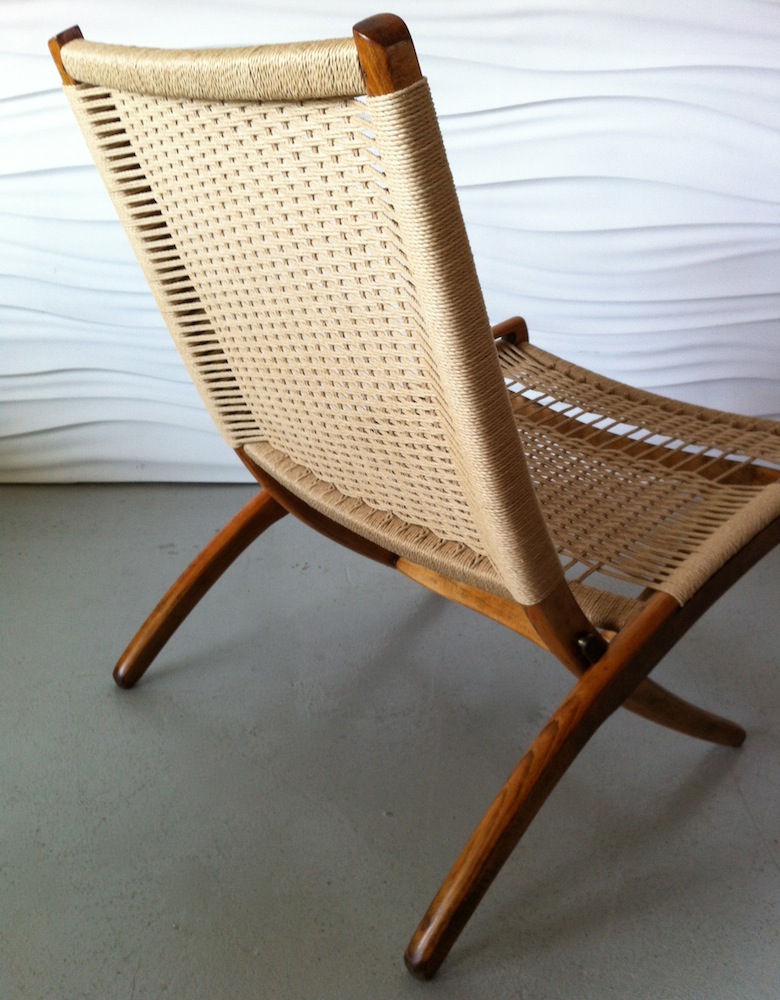 Just as good-looking from the back as from the front so you can pull them out into the room if you want.
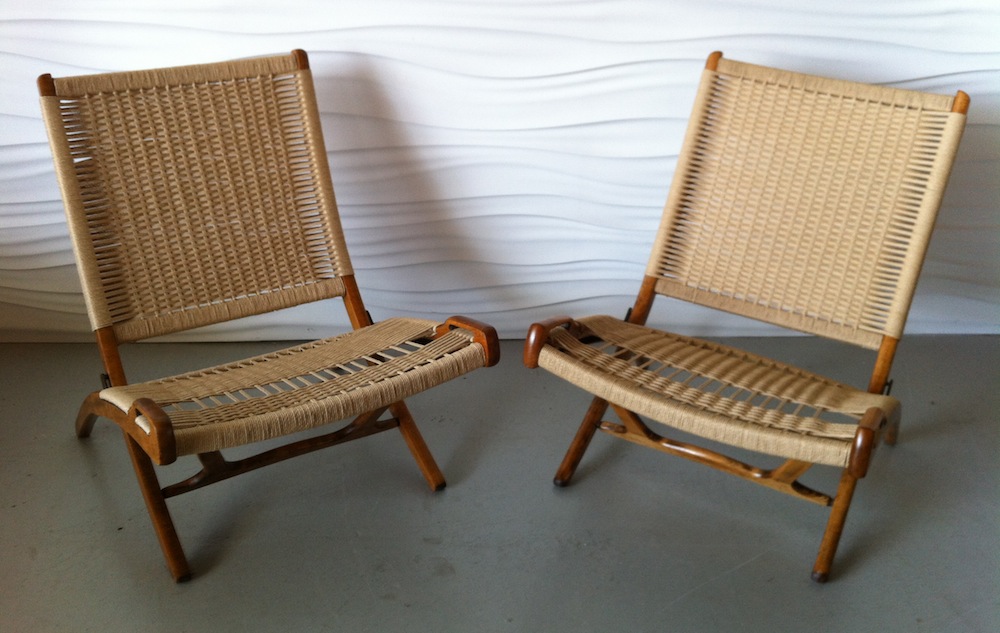
Absolutely gorgeous! Another fine job by MCR!!!
Wow! Very impressive! Would you consider sharing your tips of how you did this? Is there a tutorial out there somewhere that you followed or just from your own experience? I love to fix up mcm chairs too and this one seems to be calling my name! Any tips you can give would be greatly appreciated! 🙂
Thanks for your kind words, Heather! As much as I would like to offer instruction on the techniques that I use, I just don’t have the time what with having to earn a living at this and all. I learned from experience and from looking at other examples online and in person. It can be done. Good luck!
You did a marvelous job on those chairs! I bookmarked your website in case I can ever use your services.
Thank you!
I have this exact chair in my attic. It was passed down to us from my husband mother who bought it in the 50’s. I have been looking to have it done since about half of the cord is undone. Can you please contact me on how much it would cost to have it redone. You did an amazing job on those chairs! I live in Bel Air, Md.
Thank you!
Thanks for the kind words. I’ll email you a quote for redoing your chair.
My daughter also has this chair. Can you please give me an estimate to restore it? She lives in Philadelphia.
I’ll email you a quote for redoing your chair.
Hi, I was wondering what kind of material you used for the new weave? I also have a chair like this and was wondering where you are located in case I’d like for you to repair it. I’m in Atlanta. Thanks and beautiful job!
oops, sorry, didn’t see the “Danish paper cord” info but am still interested in a quote. Thanks!
I’m sorry, I only work with people in the Baltimore/DC area as I prefer not to deal with shipping at all.
I live in Baltimore and have two similar chairs but they have arms. They are stamped made in Yugoslavia. Can you tell me how to contact you about repairs?
Thank you
I’ll email you and we can talk about what’s needed and what it will cost.
Love your website. It’s good to see that you treat the wood as I do. Although I tend to use Danish oil which is very similar to Teak oil. When I start the cleaning, I use a 50/50 cut with white spirit (turps substitute) and the finest wire wool. Then build up with full strength.
I have a similar chair to this but yours appears to be much narrower. The back of mine measures 20.5″ high x 21″ across. Seat 18.5″ deep and 24″ across.
I have not found any maker’s marks so far but I have not started restoration – yet. It has been suggested that mine may be by Erbert Wells, and predates Wegner. Some even say that Wegner copied Wells!
Does yours have any marks which give you an idea of origin?
I am going to use a 3mm (1/8″) flagline made of “Hempex” which is a synthetic material but and feels just like the flax flagline that is on at present, which I am sure is the original.
There is a photo of the chair on the “for sale” page of my website (which is down at the moment whilst it gets hooked up with a new server”.
Sue,
These belonged to a client and I don’t have them anymore so I can’t compare measurements, but I think they were at least 20″ wide at the back. They were incised “Made in Yugoslavia”, I think on the side rail of the seat. Good luck with yours!
We have a rocking chair of the same style that was in fairly good shape. We were told the chair is an outdoor chair. Can you tell me if that is recommended for this style of chair? The chair has been used outside for quite some time now and seems to be holding up well. I’ve recently refinished the wood and now am looking for ways to condition and/or protect the rope seat base and back. Can you offer any suggestions with respect to protecting the rope from summer weather elements? Thank you so much!
I would not use chairs like these outdoors. They have wood joints that will eventually come apart if left out in rain and hot sun, plus the finish will eventually flake off. It’s very difficult to make wood weatherproof. As for the paper cord, you will definitely shorten the life of it if it is left outside. I don’t know of anything that will weatherproof it. Sorry! You could always take the chair outside to sit in and bring it back in with you when you come in. They are lightweight enough that this isn’t a big inconvenience.
Thanks so much for the quick advice. I genuinely appreciate it and will make the chair a permanent indoor resident. Thanks again!
If I were interested in having you redo my chair just like this, how would I go about finding someone to do this??
Caleb, if you are in the Washington/ Baltimore area, I would be happy to give you a quote via email. I don’t have a directory of people around the country who do this type of chair, though.
I have a similar chair and will be attempting to re-cord it. One question though, for these folding chairs, since there are no L nails to loop around, do you have to work with the Danish cord pre-cut or can you weave straight from the Danish cord roll like the regular dining chairs?
If it needs to be pre-cut, any advice on what length of cord I would need?
Matthew,
Anytime you have to wrap around a side rail instead of hooking onto L-nails, you must use a cut length of cord. Get a copy of The Caner’s Handbook for more instructions on this. I think they recommend 30 yard lengths for this though I’m not sure. Shorter is always easier when starting out. Longer lengths are more prone to tangling.
Good luck!
I have two of these chairs and one is in very bad shape. The frames are in great shape though. Can you provide me with at quote for repairing the both of them? I live in San Diego, CA. Thank you!
Sorry, Carrie, I don’t do any shipping or receiving.
I could never find an email from you about redoing my chair. Can you please contact me again with an estimate. Thank you
I have two of these chairs myself… I’ve started my restoration project with this post as a big inspiration. Do you have a rough estimate of how much paper cord is needed to refinish 2 full chairs (bottom and back) in pounds?
I buy cord in 20 lb. coils and have never calculated the weight of the cord used in one of these chairs. But you can figure it out with a little math: a 17″x18″ Moller chair seat uses 2 lbs of cord with a little left over. From that you can get the weight per square inch, then figure the area of the woven back and seat of the Yugo chair and go from there.
Thanks, MCR, this website is great resource for restoration. Keep up the good work!
Thanks for the great information. What diameter Danish Paper cord did you use for the Yugo folding chair?
The cord I used on this chair is 1/8″ diameter.
I am trying to redo my own chair but I cannot figure out how to do this weave. There are no tutorials out there. If you ever do decide to do a tutorial, please let me know. I would be most appreciative and, as I can see from the other comments, so would many others. Many thanks and I will soldier on with this project. Fingers crossed.
“The Caner’s Handbook” is very helpful for the basic weave technique, then you can just figure out the variations by looking at how it was done previously. That’s how I did it, anyway. Good luck!
I have alwasy been interested in these types of chairs, but have never had the opportunity to figure out how to properly begin and end the chord. how do you tie it off so that there isn’t a big knot sticking out for everyone to see?
Can you provide some advice? maybe some process images?
I simply tack or staple the end to the inside of the posts on the back. Or if I can’t staple it and have to knot instead, I knot it so that the knot falls between two wood members. Sometimes you have to pound the knot flat with a hammer so that it fits into the narrow space, but it can be done.
Your website is amazing and you are so patient with all our questions! I’ve recently moved from Australia to the USA. I picked up a chair like this one at the thrift store for $10 (it needs a lot of work!). Just wondering if you had any tips of spotting a real from a replica? I can’t see any stamps Made in Yugoslavia on the frame. Late last year, a company called Designcraft put a little show of Wegner furniture together in Canberra, Australia. They had a real Wishbone and a replica on display and a label with “Spot the differences”. Here’s some snaps from it http://www.alison-spence.com/blog/2014/9/29/hans-j-wagner
Alison, all you need to do is compare photos of your chair to a photos of a Wegner chair from a trusted source. (Not sure what that link is about–I didn’t see anything like what you were talking about there.)
I have the same chairs and am looking to also have them restored. Literally the exact same…how much are you looking to charge to have them restored.
Thanks, Wade
Wade, if you’re in the Baltimore/DC area, email me at info@modernchairrestoration.com for a quote. I do not do any shipping of furniture at all so you have to be able to drop your chairs off and pick them up when finished. Thanks.
Hi – I think this looks fabulous. I have just bought 4 Mogens Kold chairs that appear to use the same weaving pattern that you used here – does it have a name? I would love to be able to bring them to you but alas I am in the UK! So I am trying to find out about weaving and how I could restore the chairs myself – just having trouble finding out how to do this kind of technique with no nails front and back but with the looping method- is there any help at all you might be able to give me?
Thanks—I figured it out just by looking at the weave and undoing it. It’s easier if you work from left to right as you face the chair, and one or two steps are counter-intuitive because you have to take the cord back the way you came before going forward.
It can also get a bit confusing with all the loops of cord that look like they’re crossing over and under as required but then it turns out they’re not quite right. I still mess up sometimes and have to undo a few steps.
I drew a diagram for the weave but haven’t posted it yet. I have to write the text for it. I’ll try to get that up soon.
Funny, I was about to ask if you knew what this weave is called and where to find a diagram for the weave, and I look up and see that last post from Wendy Williams asking the same. I am building a lounge and I wanted to use this weave. Originally I wanted to use the CH25 weave but the back seems complicated and this will be my first go at danish cord. Any help pointed in the right directions would be greatly appreciated. This chair will be in an exhibit in the Maloof Foundation in a few months.
I don’t know that it has a specific name! I’m not sure any of the weaves used on Danish Modern chairs have official names, though the rush-style weave on Wishbones has a name in Denmark but I’ve forgotten what it is. I’ll have to look that up.
I’ve also never seen any books or videos covering this weave though there may be something published since my last search, which was awhile ago.
I’ll go ahead and publish my diagram. It’s very easy to do once you get the hang of it, though you do have to maintain a certain level of focus on what you’re doing because a wrong move can seem totally correct until you get a step or two past it. Suddenly you notice something’s wrong but you’re sure you did it all correctly.
You will have eased my mind! Thank you sir!… I just noticed you are in Maryland. I am from Richmond Va but currently reside in San Diego. If I here of any friends or family back home that may need some restoration work I will send them your way.
Cheers!
http://www.modernchairrestoration.com/2016/05/how-to-do-the-looped-warp-weave-on-yugoslavian-folding-chair/
Please leave any questions or comments about the process on that blog post rather than here. Thanks!
http://www.modernchairrestoration.com/2016/05/how-to-do-the-looped-warp-weave-on-yugoslavian-folding-chair/
Please leave any comments or questions about the process on that new post rather than on this one. Thanks!
Love your work! You have empowered me to attempt to refinish one of these chairs I recently acquired. My frame is in good shape but could use some refinishing. How was the wood frame on these chairs refinished. Teak oil or was it stripped, restrained and clear coated. I appreciate your advice. Thanks
I didn’t do the refinishing on these but I’m pretty sure they were stripped, stained and then coated with clear lacquer. The originally finish is either a stain plus clear lacquer, or a tinted lacquer and the wood is almost always beech. You could oil it, I guess. I prefer to just strip the whole thing and do an ebonized finish with India ink and then paste wax for a soft glow.
I love the modifications you did , It looks so much sleeker. Can you tell me what size Danish paper cord you used ?
Most Danish paper cord is 1/8″ diameter, give or take a hair. There is also a 1/4″ diameter but most places do not carry that size. It was used on some Danish chairs but would not work on the Yugoslavian chairs very well, in my opinion. I have always just used the 1/8″ diameter cord.
Thank you .
I was repairing a chair like this a few years ago for a esteemed customer.
This seat is verry hard to make. If my memory serves me well I needed around 200-250 meters of rope, 4 mm thick
And I needed 16 hours of knitting to make a whole chair.
I am about to start another one; I’ll try to remember to record the total weight of the cord that I use on it. I think the first one I did probably took me 15-16 hours but with practice I’ve gotten it down to more like 9 or 10. Anytime you have to pull the entire length of cord through on each pass, you add a lot of time. The L-nail system is so much faster!
MCR, I just read a few of the posts regarding the Wegner/Wells rope chairs. Was fortunate enough to pick up a couple. Do you have any recommendations for specialists in repairing them in the San Francisco Bay area?
Thanks.
I don’t have a nationwide directory of people who do this work, but you could call The Caning Shop in Berkeley, CA and ask if they have recommendations. Jim Widess is the owner and he wrote The Caner’s Handbook which has great instructions on how to do the more common Danish chairs with paper cord. It’s where I learned to do the craft.
I casually found this website and I write you because my parents had and we still have, these same chairs bought in Spain around 191965…the wood rather reddish but both in perfect shape!
I just seen you repair on the Wegner style chair it looks very nice I was wondering what kind of training have you had ,have you attended any courses or classes? I too have a small business Retro Relics & ,Restorations I’m in Iowa so no competition lol .A friend of mine brought me a Wegner style rocking chair and ottoman it was my very first weave and my second restoration.so like I said I live in Iowa and unless you order materials I’m limited so my thoughts what is the longest cord I can find near me I ended up buying black Paracord from walmart.when u took the chair apart I drew sketches of the weave and counted the wraps and knots.the chair and ottoman where abandoned in the house so I sanded both pieces and used a darker walnut stain.i amazed myself finished them in a couple days and gave myself a pat on the back .so just wondering about any training for courses you know of I’ve taught myself even to use a industrial sewing machine I restore pretty much everything but glass that’s what I tell my customers.thanks keep keeping on
I am self-taught. There are classes in weaving chair seats but I enjoy the process of figuring it out on my own or from a book (“The Caner’s Handbook” by Jim Widess and Bruce Miller is the one I used and I highly recommend it–available new but there are often used copies on Ebay for cheap). There are also some very good videos on youtube for various techniques.
Check out local adult education courses in your area, too.
Most of us have to order Danish paper cord online and the shipping is expensive because it’s so heavy. The price of the cord has gone up a lot in the last few years, too–probably due in part to what US distributors pay in shipping to get it from Sweden where the best quality cord is made. You can get paper cord made in southeast Asia but it’s generally thinner and not as strong.
I have 2 of these chairs and I believe they are originals. Mine have arms. I bought them at auction over 30 years ago. What would there value be today? I love them.
I don’t track furniture sales so have no idea what current value of anything is, but it’s easy enough to find online. Just look online for what those chairs have sold for. Ebay is the biggest source of information on this—do a search for the chair, then look at “completed listings”. This will show you not just what has sold and for what price but also what didn’t sell (often because it was priced too high). You have to take condition into consideration—and the cost of shipping, too.
You will also see a lot of asking prices when you research this way. These are often not what the seller gets in the end, but are more of a starting point. Sometimes they take way less than the asking price. A lot of people who have a nice chair or whatever will see it on 1stDibs, for instance, for $1500 and will think that’s the going price. It rarely is in reality.
I have a chair similar to this that needs some work. Do you have a video showing how you did this repair? And where can you get the Danish paper rope
Directions for how to do the back weaving on this chair are here. I don’t have paper cord weaving instructions in general but there are some good youtube videos and websites that show how. I learned how to do it from the book by James Widess, The Caner’s Handbook: A Descriptive Guide With Step-By-Step Photographs for Restoring Cane, Rush, Splint, Danish Cord, Rawhide and Wicker Furniture. You can usually find used copies on Ebay for cheap.
Danish paper cord is available online from several places across the US and a few in Europe. It’s very heavy and shipping is a significant part of the cost so just google and find the best deal. Beware of paper cord that is a lot cheaper than most; this is often thinner and less durable.
Please can you help me get started. I have redone 6 mohler chairs and familiar with the pattern you chose for the repair. However I want to know how to get started without nails. I’d be up for a zoom call if you are willing. Please contact me by email.
Thanks
NM
“The Caner’s Handbook” by Jim Widess has excellent instructions for weaving the seat of a nail-less paper cord seat.
I created a diagram a few years ago on how to do the back. It’s posted here: http://www.modernchairrestoration.com/2016/05/how-to-do-the-looped-warp-weave-on-yugoslavian-folding-chair/
They look beautiful. I have two. There are a few stains on one. The other has a cracked rear leg. I was wondering if they could be fixed? How should I clean the stains.
Ayse
Frames can usually be repaired. Consult someone knowledgable with furniture repair. (This is not one of my skills.)
As far as cleaning paper cord, grate a bar of of Ivory soap (only Ivory, not other brands). Dissolve 2-3 tablespoons of grated soap in a quart of hot water. Let it cool and then sponge onto the paper cord seat. It will soak into the cord and push at least some of the dirt to the top.
Get all of the cord evenly damp, even around the sides and the back where it shows. You will end up with water lines if you don’t get all of it damp.
The cord will stretch and sag when damp, but don’t worry—it will tighten up when dry. Do NOT sit in the chairs until they’re completely dry. This will take a 1-3 days depending on humidity. Run a fan on them to speed up drying.
The soap treatment won’t remove all stains but it can make the chair look more presentable.
I love what you have done. I have the same chair, knots Etc., and need to replace the cord. Did you do a tutorial on how to do this? I think I can do this but need to know where to start. Any guidance would be greatly appreciated!
I don’t have a tutorial on how to weave these chairs and have no plans to do one. Someone else may have written up something by now or maybe made a Youtube video on it; I don’t keep up with this stuff since I no longer do seat weaving.
I learned by looking at the original weaving. I had a lot of trouble remembering how to get started on them because there were always long gaps between these jobs, so I finally wrote down how to do it and made some diagrams so that it’s very clear. I shared this in a post on this blog. You’re more than welcome to consult that, but that’s all I have to offer at this time. (It’s only how to do one aspect of the weave, but it’s the one that throws most people off. The other techniques are just general Danish cord weaving stuff; there are a lot of videos and tutorials online about that.)
link here: http://www.modernchairrestoration.com/2016/05/how-to-do-the-looped-warp-weave-on-yugoslavian-folding-chair/#comment-135913
I need instructions for a vintage Yugoslavian Danish style rocker. It’s for the seat.
I need instructions for a vintage Yugoslavian Danish style rocker. I would appreciate it if you could email this information.
I need instructions for a vintage Yugoslavian Danish style rocker. I would appreciate
you emailing this information
Sorry, I don’t have any written instructions for doing these and I don’t offer tutorials.
I have a similar chair that needs wood restoration and re-weaving (looks like the ‘before’ picture) – do you do restoration on commission? Or only the ones you find yourself?
I am no longer doing any seat weaving. I don’t keep a list of others who do this work but an internet search will yield some names.
Hi there-
I just bought a pair of these chairs on craigslist, and like yours the cotton cord is very stretched out. They’re usable, but due to the saggy cord, the rear support bar across the back of the seat is prominent and uncomfortable to sit on. Now that you’ve redone these with Danish cord, can you sit all the way back and not feel the bar across the back of the seat? I’ve been thinking of how I’d like to re-do these, and am torn between simulating the original in Danish cord, as you did, or using cane in a style more similar to the Wegner JH 512.
Thanks for reading this, and for sharing any thoughts you might have.
A properly-woven seat of Danish paper cord does not sag and you can’t feel the cross piece when sitting. I think the same is true of cane. In my opinion, paper cord is a lot easier to work with than cane if you’re new to caning.
Hi- I see at the top under “Recent comments” that it looks as if you may have responded to my question. For some reason, I’m not able to view any comments, including my own or your response. I’ve tried on a couple different browsers. It doesn’t look like there’s any way to create an account or to log in, so I don’t think it’s that.
If I’m doing something wrong, and if you have the time to do so, please let me know via email. I understand that’s a lot for a stranger to ask, so no harm if you’re not able to do that.
Cheers,
Aaron
Beautiful job!
I have the exact chair with the same worn cotton weave problem. How long did it take you to reweave with Danish Paper Cord
Where are you located Do redo chairs for customers
As stated on the main page of this site, I no longer do chair restoration at all.
It’s been quite awhile since I wove one of these chairs and I don’t really remember how long they take. If you’re new to it, it will take you longer than if you’ve got some experience. Maybe 12 hours? Rough guess.