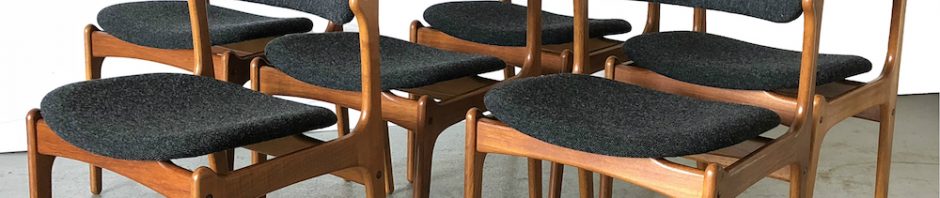

I just finished this set of six Erik Buch dining chairs in one of my favorite fabrics, Maharam/Kvadrat’s Hallingdal in the 180 colorway, a very dark charcoal gray. All the photos here are deliberately overexposed a bit so that the details are visible. The actual fabric color is darker (swatch below).

Hallingdal was designed by Nanna Ditzel of Denmark in 1965 and has been in production ever since. It’s 70% wool, 30% nylon for durability, and comes in 57 other gorgeous colors besides this charcoal gray.

The original seats had the usual beige wool that was used many Buch chairs. It was very, very dirty. When the fabric is this bad, you can pretty much count on the foam being dirty, too.

The frames were in pretty good shape except for a few large, dark mystery stains. This one was on the outside surface of the top of one of the leg posts. Fortunately I was able to get it out!


These chairs have always been my favorites for comfort. The secret seems to be in the shape and angle of the backrest.

Hallingdal is a very sturdy fabric that will last for decades with reasonable use. It also goes around curves beautifully and is easy to work with.
✢ ✢ ✢
I have a set of 4 Dyrlund dining chairs. I’m looking for a replacement part to attach the seat to the frame. Any idea where I can source these?
I’m not familiar with all the Dyrlund chairs so I have no idea what the part you need looks like. You might try the sources listed on the right side of my blog. Posting photos of the chair and the part on the DesignAddict.com forum in the repairs section might be helpful to you, too. There are people on there who might know. Good luck.
I’m just about to reupholster some of the same chairs and was thrilled to see your posts. They are a total godsend.
Did you ever look into striped fabric? I’m about to order a fine-striped (not bold) Knoll fabric for the job. I will attempt to match the stripes from the back to the seat. What is your opinion on having the same repatition of lines across all chairs?
Thanks,
Gabrielle
I’ve upholstered with striped fabrics. I’m not sure what you’re asking, though—do you want to know if you can orient the strips both horizontally and vertically on the same chair? If so, sure—if you like that look. Upholstery is reversible if done properly, so do what you like. If you want to know if I’ve ever done chairs with some stripes going vertically on some of the backs and horizontally on the other backs, then no–I like all the chairs to look the same.
I do think stripes on mid-century modern chairs generally look best when horizontal but that’s not a hard and fast rule. Horizontal lines were just more the thing in that era in general—long, low sofas, low-back chairs, etc. But vertical stripes can look great too.
You should match up patterns from one section to another on a chair, though, like the inside back and the outside back, side boxing on a seat cushion, etc.
Beautifully done!
I’m redoing some Erik Buch counter height stools, that basically have a #49 seat, that were at least that dirty. I’m a first time upholsterer. I’m doing it because I love the stool and am keeping them. I got Knoll fabric.
What did you do for the dirty foam? Replace it? If so, what with? How’d you get the contouring and rounded edge? Or did you just clean it with something?
And have you ever had to replace the plywood seat? One of the stools seems to have some flimsy plywood or a break or crack or something.
Thanks in advance for ANY help that you might be able to provide!
Sincerely,
Travis
Replace dirty foam with clean 1″ thick high density upholstery grade foam (not foam from fabric & craft stores). Buy it online.
Cut the foam 1″ bigger than the wooden seat, attach it to the seat using spray adhesive, then trim at a right angle to the surface about 3/4″ from the edge. Do another trim angled from the top surface of the foam to the underside where it meets the wood. Use NEW safety razor blades to do this and use a new blade for each seat as they dull quickly. Then use a light application of spray adhesive (test first on fabric to make sure it doesn’t soak through) to attach fabric to foam. (Cut fabric 3″-4″ bigger than seat on each side.) Wrap it around the seat and tack at mid point on each side, then work out from each mid point a few staples per side at a time, smoothly fabric and keeping tension as you work. Tack center of each corner and work around from center out, makeing small, neat pleats in the fabric, always pulling towards center of seat.
Trim excess fabric close to the staples and cover underside with buckram stapled in place. Trim close to staples. I highly recommend using a pneumatic upholstery stapler and compressor.
I’ve never replaced the plywood seats so I can’t help you there.
Thanks for your article! I am building a replica and I’m curious how the seat back is constructed and how it attaches to the sides.
The back is a piece of 1/2″ thick curved plywood. The outer back is chipboard covered with fabric. The back attaches to the frame with two dowels and two wood screws on each side. The screw heads are countersunk and covered with teak plugs (metric sizing).